Rollover accidents are exceptionally dangerous and frightening – something you already know all too well if you’ve been involved in one. The car accident attorneys at Butler Kahn know this, too. That’s why we are proud to represent those who’ve been hurt in rollovers in the Atlanta area, helping them demand fair compensation from those responsible for their injuries. We can guide you through the legal process and handle all the details of your case for you while you focus on your recovery. When you hire Butler Kahn to represent you, you can rest assured your case is in the hands of experienced, aggressive, and effective attorneys.
Want to speak with an Atlanta rollover accident lawyer for free? Then contact Butler Kahn today. You will never pay any out-of-pocket fees for our representation, as we only charge a fee if we win.
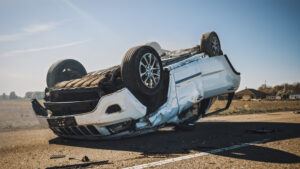
A rollover accident happens when a car overturns onto its side or roof, sometimes turning over several times until coming to a stop. Rollover accidents are incredibly dangerous, as occupants are jostled around or sometimes ejected from rolling vehicles as they tumble over. Per the Insurance Institute for Highway Safety (IIHS), rollover crashes accounted for nearly 30 percent of passenger vehicle occupant deaths nationwide in one recent year.
What Causes Rollover Accidents?
Many different factors can contribute to rollover accidents, including driver error, vehicle defects, and environmental factors. Common causes of rollover accidents include:
Speeding – Rollover accidents often occur when vehicles move at excessive speeds. Many rollover crashes occur on roads with higher speed limits, especially highways.
Steering maneuvers – Abrupt steering maneuvers, such as overcorrecting or swerving to avoid obstacles, can cause vehicles to tip over.
Tripping – Tripping is when a vehicle’s tires strike an object, such as a curb, pothole, or debris, that causes the vehicle to tilt and roll over.
Driving under the influence – Many fatal rollover crashes involve drivers with blood alcohol levels (BACs) above the legal limit, who are more likely to take dangerous risks.
Road conditions – Poor road conditions, such as potholes, uneven pavement, loose gravel, or other roadway hazards, can also cause rollover accidents.
Bad weather – Environmental factors, including high winds, ice, snow, heavy rain, and flooding, can all increase the risk of a rollover accident.
Are Some Vehicles More Likely to Roll Over than Others?
Certain types of vehicles, such as SUVs, vans, and trucks, are more prone to rollovers due to their higher centers of gravity and narrower wheelbases relative to their height. According to the IIHS, rollover crashes accounted for 21 percent of car occupant deaths but a staggering 40 percent of pickup truck occupant deaths and 38 percent of SUV occupant deaths.
Older vehicles without modern safety features, such as electronic stability control (ESC) systems, are also often more susceptible to rollovers. Federal regulations now require ESC systems on all passenger vehicles, trucks, and buses with gross vehicle weight ratings (GVWRs) of 10,000 pounds or less.
What Are the Most Commons Injuries from a Rollover Accident?
Rollover accidents can result in serious injuries, including the following:
Traumatic brain injuries (TBIs)
Spinal cord injuries
Broken bones
Amputations
Internal organ damage
Contusions and lacerations
Neck and back injuries
Soft tissue injuries
What Can a Driver Do to Prevent a Rollover Accident?
To prevent rollover accidents, all drivers should practice safe driving habits, such as:
Regularly checking and maintaining tire pressure
Performing regular vehicle maintenance
Avoiding excessive speed
Refraining from overloading vehicles
Staying alert and focused on the road
Keeping a safe distance from other vehicles
Avoiding sudden maneuvers, turns, or braking
Understanding a vehicle’s center of gravity and handling abilities
Never driving after drinking or taking drugs
Adhering to posted road signs and warnings
Adjusting driving behavior in bad weather
Taking extra care on rural roads without barriers
Can Someone Be Held At Fault for an Atlanta Rollover Accident?
Each rollover accident is the product of a unique set of circumstances. They often involve some combination of driver error, poor roadway maintenance, and defective components or vehicle design. Depending on the accident in question, one or more of the following parties could be at fault for a rollover accident and liable for its consequences:
Another driver – If another driver acted negligently in a way that contributed to the rollover accident, you could hold them responsible for the harm you suffered. Examples of driver negligence include speeding, distracted driving, and driving under the influence.
A vehicle manufacturer – A manufacturer could be liable if a defective vehicle part or design flaw contributed to the rollover accident.
A government agency – If road conditions like poor maintenance or missing signage contribute to the accident, the government agency responsible for the road could be liable.
What Compensation Is Available for My Rollover Accident Injuries?
If you suffer injuries in a rollover accident caused by someone else’s negligence, you could seek compensation from the at-fault driver for the following accident-related losses:
Medical bills
Lost wages
Loss of future earnings
Pain and suffering
Mental and emotional distress
Loss of enjoyment of life
Do I Have a Time Limit for Filing a Car Accident Claim in Georgia?
Under Georgia law, you generally have two years from the date of a rollover accident to file a personal injury lawsuit. This deadline is important even if you hope to resolve your claim through an insurance settlement. Consulting an experienced personal injury lawyer in Atlanta as soon as possible can help you understand the applicable deadlines, preserve important evidence, and protect your legal options. Acting promptly may also strengthen your position during negotiations with the insurance company.
Contact an Atlanta Rollover Accident Lawyer
If you are reading this page because you or a loved one has been hurt in a rollover accident, we hope you’re getting the care you need to make a full recovery. We hope you’ve found the information on this page helpful. If you’d like to speak with us about your situation, call Butler Kahn or contact us online. There is no charge to talk with us about your case.
Frequently Asked Questions
A rollover happens any time a vehicle tips onto its side or roof, whether it flips once or tumbles multiple times before stopping. These crashes aren’t limited to high-speed highway wrecks — a rollover can occur at relatively low speeds if a vehicle’s tires catch a curb or soft shoulder at the wrong angle. Because the forces involved are so unpredictable, rollovers tend to cause more severe injuries than a typical collision.
Not necessarily. Insurance companies often try to pin single-vehicle rollovers entirely on driver error because it’s the cheapest explanation for them, but a defective tire, a hidden road hazard, or a design flaw in the vehicle itself can all be the real cause. An attorney can investigate whether something other than driving behavior triggered the crash.
Yes. Vehicles with a high center of gravity, a weak roof structure, or a stability control system that failed to engage can all contribute to a rollover or make the injuries worse once it happens. When a design or manufacturing defect played a role, the manufacturer — not just the driver — may share liability under Georgia product liability law.
Reconstructing a rollover usually involves examining skid marks, vehicle damage patterns, and the roadway itself, sometimes with help from an accident reconstruction expert. If a defect is suspected, the vehicle needs to be preserved and inspected before it’s repaired or scrapped, since that evidence tends to disappear quickly.
Roof crush is one of the leading causes of catastrophic spinal cord and brain injuries in rollover crashes. If the roof structure collapsed into the passenger compartment, that can point to a separate defect claim against the manufacturer, even if driver error contributed to the rollover itself.
Rollovers are especially common on Georgia’s interstates and rural highways, where higher speeds and less-forgiving shoulders give drivers less room to recover from a swerve or tire failure. Curved on-ramps and roads with steep embankments also see a disproportionate share of these wrecks.
Not wearing a seatbelt can affect a damages claim in some situations, but it doesn’t automatically bar you from recovering compensation in Georgia. The at-fault party’s insurer may raise it as a factor, which is one more reason to have an attorney review the specifics of your case rather than assume your claim is dead on arrival.
Yes — vehicles with a higher center of gravity and narrower wheelbase relative to their height, like SUVs, pickups, and vans, are statistically far more prone to rolling over than passenger cars. That’s part of why rollovers account for a disproportionate share of pickup and SUV occupant deaths compared to other crash types.
If a family member died in a rollover crash, Georgia law allows certain surviving relatives to pursue a wrongful death claim against the at-fault driver, a negligent government agency, or a manufacturer, depending on what caused the crash. These cases can involve more than one liable party, so it’s worth having an attorney sort out who’s responsible before accepting any settlement offer.
A straightforward rollover claim against another driver might settle within several months, but cases involving a suspected vehicle defect or a government road-maintenance issue often take considerably longer, since they require expert analysis and, sometimes, litigation against a manufacturer. Your attorney can give you a more realistic timeline once they understand what caused your specific crash.
Jeb ButlerState Bar: #116955
Jeb Butler’s career as a Georgia trial lawyer has led to a $150 million verdict in a product liability case against Chrysler for a dangerous vehicle design that caused the death of a child, a $45 million settlement for a young man who permanently lost the ability to walk and talk, a $3,973,260 settlement after a boating accident, and a $1,250,000 settlement in a pedestrian case, and numerous other verdicts and settlements, many of which are confidential at the defendant’s insistence. Jeb has worked on several cases that led to systemic changes and improvements in public safety. He has been repeatedly recognized as a Georgia SuperLawyer and ranks among Georgia’s legal elite. Jeb graduated in the top 10% of his class at UGA Law, argued on the National Moot Court team, and published in the Law Review. He is the founding partner of Butler Kahn law firm. Connect with me on LinkedIn