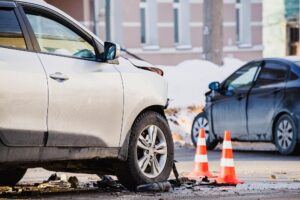
The aftermath of a left-turn accident in Atlanta can leave you feeling overwhelmed by medical bills, income loss, car repairs, and insurance claims. Any accident’s financial, physical, and psychological toll can be significant. Why should you bear the burden of an accident someone else caused?
At Butler Kahn, we understand what you’re going through. Our trusted left-turn accident lawyers can help you through this difficult time by advocating for your rights and demanding the compensation you deserve from the driver who hit you. We represent Atlanta crash victims who have suffered injuries in a range of accidents, including left-turn collisions. With years of experience and a track record of success, we have what it takes to provide the personalized and effective legal representation you need.
Contact Butler Kahn today to speak with one of our Atlanta left-turn accident lawyers. Your initial consultation is free, and you will never pay anything out of pocket to have us start work on your case.
What Are the Main Causes of Left-Turn Accidents in Atlanta?
Left-turn accidents in Atlanta can occur for various reasons. Some common causes include the following:
Failure to yield the right-of-way
Distracted driving
Misjudging distances
Poor visibility
Impaired driving
Speeding
Disobeying traffic lights or signs
Where Do Most Left-Turn Accidents Occur in Atlanta?
Most left-turn collisions occur at intersections where two or more roads meet and vehicles must cross in front of one another. Data from the Federal Highway Administration (FHWA) suggests half of all crash-related injuries and a quarter of all crash deaths occur at intersections.
One local news reporter investigated the most dangerous intersections in Atlanta and found the following areas are particularly accident-prone:
Memorial Drive and N Road in Stone Mountain
East Park Place and Stone Mountain Highway in Stone Mountain
Covington Highway and Lithonia Road in Lithonia
Cobb Place Boulevard and Earnest Barrett Parkway in Kennesaw
Jimmy Carter Boulevard and Peachtree Industrial Boulevard in Norcross
What Injuries Occur Most Often in Left-Turn Accidents?
Injuries in left-turn accidents can vary based on the vehicles’ speeds, the point of impact, and other relevant factors. Some common injuries from left-turn collisions include:
Whiplash
Head injuries
Back injuries
Spinal cord injuries
Broken bones
Internal injuries
Soft tissue injuries
Cuts and bruises
What Are Georgia’s Left-Hand Turn Laws?
Under Georgia law, drivers who intend to turn left at intersections or onto other roads must yield the right-of-way to any vehicles approaching from the opposite direction close enough to be an immediate hazard.
According to Georgia’s Drivers Manual, drivers should follow these steps to complete a legal left turn:
Use the left-turn signal to give drivers ahead of and behind you enough notice.
Move into the far left traffic lane or a turning lane if available.
Keep your wheels pointed straight until it is safe to begin the turn.
Yield the right-of-way to all other road users approaching from the opposite direction.
When it’s safe and traffic lights or signs permit, make the left turn.
Once you have entered an intersection, do not change lanes until you complete the turn.
Who Can Be Held Liable in a Left-Turn Accident?
Any of the following parties could be responsible for a left-turn accident in Atlanta:
The left-turning driver – A driver making a left turn could be liable for an accident if they don’t yield to oncoming traffic, make an improper turn, or otherwise drive negligently.
Another road user – While the driver turning left is most often responsible for a subsequent collision, other motorists are sometimes to blame. Another road user, such as a pedestrian or cyclist, could also be at fault if they disrupt traffic in a way that contributes to an accident.
The driver’s employer – If the driver responsible for the accident was on the job at the time, their employer could bear responsibility for the employee’s actions.
A government agency – When poor road conditions like faulty traffic lights contribute to an accident, the government agency responsible for maintaining local roads could be liable.
A vehicle or component manufacturer – The company that designed or manufactured the vehicle or its components could be held accountable if a defect like faulty brakes or a malfunctioning steering system causes a wreck.
When May the Driver Turning Left Not Be At Fault?
Most often, the driver turning left is at fault for a left-turn accident. However, there are times when the left-turning driver might not be at fault. For instance, another driver could be liable if they were:
Speeding
Running a red light or stop sign
Impaired
Violating the right-of-way
Distracted
What Damages Can Be Recovered for a Left-Turn Accident?
In Georgia, accident victims can recover compensation from liable parties for the following types of accident-related losses:
Medical expenses
Lost wages and benefits
Loss of future earnings
Pain and suffering
Mental anguish
Emotional distress
Loss of enjoyment of life
Is There a Deadline for Filing a Car Accident Claim in Georgia?
In Georgia, you typically have just two years from the accident date to sue. If you try to file a lawsuit after that deadline, the court will almost likely dismiss the case.
Two years might seem like plenty of time to file a lawsuit, but that’s no reason to delay. It takes significant preparation to file a lawsuit. If you wait too long, you risk losing key evidence and leverage in negotiations with the at-fault party. It’s important to act quickly after a left-turn accident by consulting an attorney who can start preparing your case.
Contact an Atlanta Left-Turn Accident Lawyer
If you have found us because you or a loved one has been injured in a car accident, we sincerely hope you’re recovering quickly with the medical care you need. Hopefully, the information here has been useful. If you want to speak with us about your situation, call or contact us online. There is no charge to talk with us about your case.
Frequently Asked Questions
Not always, though it’s the most common outcome. Georgia law requires a left-turning driver to yield to oncoming traffic close enough to pose an immediate hazard, so if they followed that rule properly and the other driver was speeding, ran a red light, or was otherwise negligent, fault can shift to the oncoming driver instead.
Under O.C.G.A. § 40-6-71, a driver preparing to turn left must yield the right-of-way to any vehicle approaching from the opposite direction that’s close enough to be an immediate hazard. Georgia’s Driver’s Manual also calls for signaling early, moving into the proper turn lane, and keeping wheels pointed straight until the turn can be made safely.
Yes, it can shift things significantly. If you had a protected green arrow and another vehicle entered the intersection anyway, that driver — not you — would typically bear responsibility, since a protected arrow means oncoming traffic is supposed to be stopped.
When the oncoming driver was speeding, distracted, or disobeyed a traffic signal, that conduct can shift fault away from the left-turning driver entirely. This is one of the more common ways a left-turn accident case gets litigated, since insurers for the oncoming driver often assume their policyholder is automatically in the clear.
Local reporting has flagged intersections such as Memorial Drive and N Road in Stone Mountain, and Jimmy Carter Boulevard and Peachtree Industrial Boulevard in Norcross, as particularly accident-prone. Intersections with heavy traffic volume and limited visibility around turn lanes tend to see the highest concentration of these crashes.
In some cases, yes — if a pedestrian or cyclist disrupts traffic flow unexpectedly, that can contribute to a crash between two vehicles. More often, though, cyclists and pedestrians are the ones injured by a left-turning driver who failed to see them, since turning drivers are frequently focused on oncoming car traffic rather than the crosswalk.
If the driver responsible for the left-turn accident was on the clock for their employer, the employer may be held liable for the employee’s negligence under a legal theory called respondeat superior. This can matter significantly for your recovery, since commercial policies often carry higher coverage limits than a personal auto policy.
Georgia follows a modified comparative negligence rule, meaning your compensation can be reduced by your percentage of fault, and you’re barred from recovering anything if you’re found 50% or more responsible. In left-turn cases, insurers sometimes try to argue the injured party shares some blame specifically to trigger this reduction.
Traffic camera footage, the police report, witness statements, and vehicle damage patterns are all useful for reconstructing who had the right-of-way. Timing evidence — such as how long a light had been green or how far away the oncoming vehicle was — often becomes the crux of these disputes.
You generally have two years from the date of the crash to file a personal injury lawsuit in Georgia. Evidence like traffic camera footage and witness memory fade quickly, so waiting until close to the deadline can make your case noticeably harder to prove.
Jeb ButlerState Bar: #116955
Jeb Butler’s career as a Georgia trial lawyer has led to a $150 million verdict in a product liability case against Chrysler for a dangerous vehicle design that caused the death of a child, a $45 million settlement for a young man who permanently lost the ability to walk and talk, a $3,973,260 settlement after a boating accident, and a $1,250,000 settlement in a pedestrian case, and numerous other verdicts and settlements, many of which are confidential at the defendant’s insistence. Jeb has worked on several cases that led to systemic changes and improvements in public safety. He has been repeatedly recognized as a Georgia SuperLawyer and ranks among Georgia’s legal elite. Jeb graduated in the top 10% of his class at UGA Law, argued on the National Moot Court team, and published in the Law Review. He is the founding partner of Butler Kahn law firm. Connect with me on LinkedIn